
Learning Path: VJing with TouchDesigner
A fixed tool decides what my visuals can do
You play visuals to music and want a system of your own for sets, collaborations and installations. Resolume and similar tools stop where their makers stopped, and building your own looks too hard to start.
- Structure:
- 4 levels, 25 modules, 75 lessons
- Video:
- 43 h in total
- Pace:
- Weekly · all on request
- Access:
- 2 years
- Language:
- English
- Level:
- Beginner to advanced
About the course
Aboutthecourse
- 01
the starting point
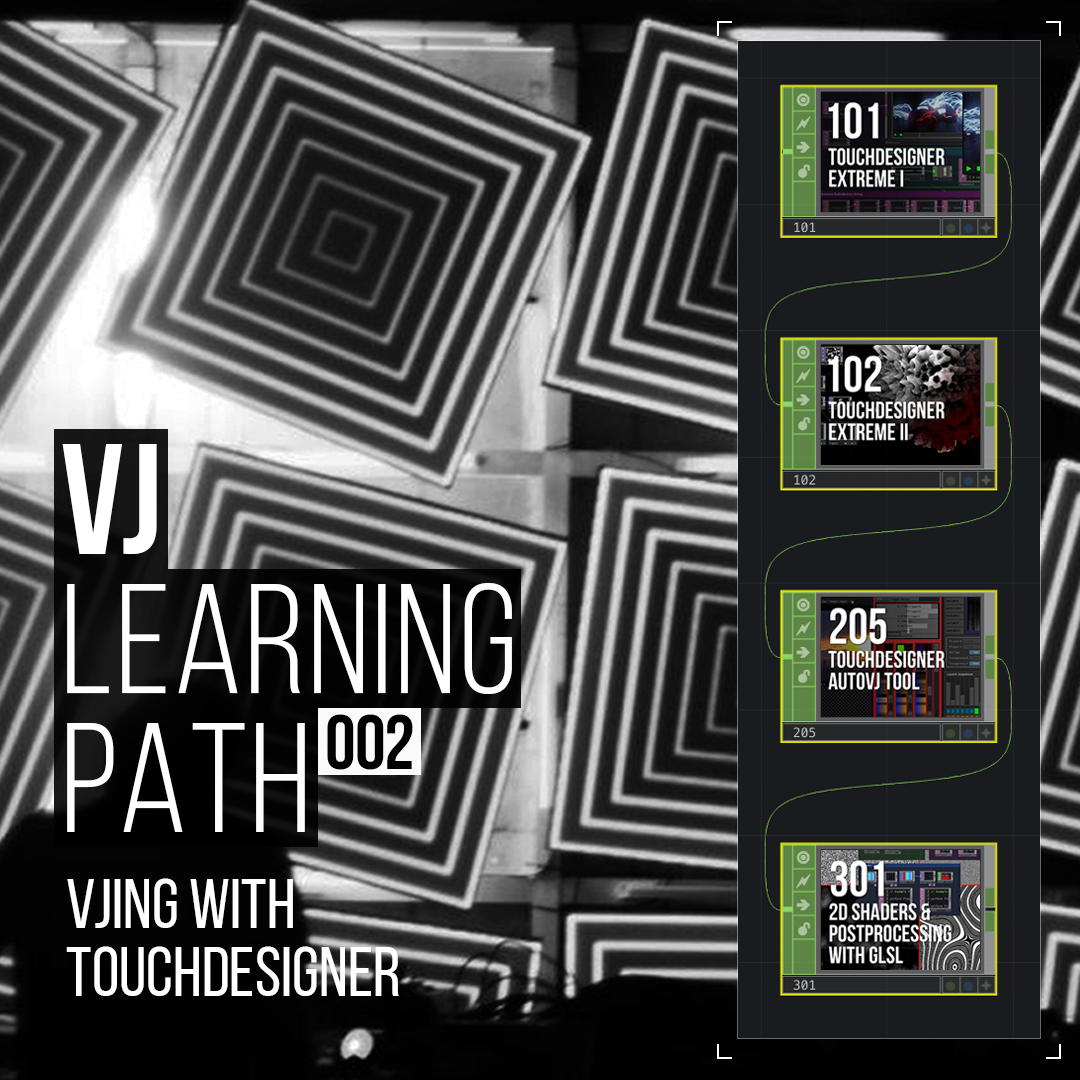
This path is for you if you play visuals to music, or are starting to, and want more than a fixed tool such as Resolume, Modul8 or VDMX can give you. Its courses are chosen for one task: building your own live visual system in TouchDesigner and writing the effects that run in it.
- 02
what you build
In Extreme I you learn the node-based way of working, turn sound into control signals and build a movie player; in Extreme II you add procedural geometry, instancing and live input. In VJTool you build your own VJ tool block by block on that ground and connect it to Resolume, so your current setup stays in use. In 2D GLSL you then write and port the shaders yourself, so your effect library can grow with your own procedural images and stylised looks.
Course modules
- Foundations & Interface ·
- CHOPs, TOPs & Compositing ·
- Audio-Reactive scene ·
- Procedural & Modular AV (layout/output) ·
- Media Playback ·
- Timer, Segments & Custom Player ·
- Animation, Recording & Sync ·
- 3D — Bridge to 102 ·
Who this course is for
For you if
- Visual artists — You build a live visual system of your own in TouchDesigner, where images react to the music through a sound analyser and run on one or several screens.
- VJs — You go past what a fixed tool lets you do: you build your own from a movie bin, a sound analyser and a GLSL effect library, and keep Resolume in your setup over OSC.
- Musicians — Your playing drives the image: a three-range sound analyser and a sound-modulated slider interface turn what you play into changes on screen.
- Creative coders — You write the effects of your live system yourself: GLSL shaders for procedural images and stylised looks, and Shadertoy shaders ported into TouchDesigner.
Not for you if
- –you do not meet the requirements in “Before you start”
- –you already work in TouchDesigner at the level of Extreme I and II → take the rest of the path with the upgrade for €1,195
Before you start
No prior TouchDesigner experience is required; general computer literacy and a machine able to run TouchDesigner.
Prerequisites: none
- 01Build real-time interactive images in TouchDesigner driven by sound through a reusable analyser, with a movie player timed from one timer and synced across machines, and a basic 3D scene with animated Houdini import, shown on one or several screens.
- 02Build procedural geometry from attribute data and GPU-instanced systems, and render them in lit real-time 3D scenes driven by live input such as particles, rigid bodies, Kinect, interface events and Ableton.
- 03Build your own VJ tool in TouchDesigner from a movie bin, a three-range sound analyser with clock-divider routing, a selectable GLSL effect library and a sound-modulated slider interface, and integrate it with Resolume over OSC using a 16-step sequencer and EDL cueing.
- 04Create GLSL fragment shaders in TouchDesigner for your effect library: procedural images, colour correction, multi-sample and stylised effects, with reaction-diffusion feedback explained and Shadertoy shaders debugged and ported in.
Programme
TouchDesigner 101: Extreme I
Beginner · 8 modules · 12 hExtreme was my first TouchDesigner course, and the name is the goal: to take a beginner and, extremely fast, build a deep understanding of how a node-based environment works. It brings you into the procedural way of thinking, explains the contexts and gives you enough working practice to use TouchDesigner confidently at an intermediate level. Part 1 keeps the complexity of geometry out of the way, so it does not frustrate you. You learn the interface and the node architecture, work with CHOP data and control parameters, play back content and build your own timer-driven movie player, and then work mostly in the TOP context: compositing, colour, feedback and generative images, with sound-reactive control. You also animate, record and keep several patches and machines in sync. It ends with the basics of building 3D scenes, as a bridge to Extreme 2.
- Foundations & Interface
- CHOPs, TOPs & Compositing
- Audio-Reactive scene
- Procedural & Modular AV (layout/output)
- Media Playback
- Timer, Segments & Custom Player
- Animation, Recording & Sync
- 3D — Bridge to 102
TouchDesigner 102: Extreme II
Beginner/intermediate · 8 modules · 11 hExtreme 2 goes deep into how geometry works in TouchDesigner. You learn the data behind every SOP — points, vertices, primitives, normals, groups and attributes — and use it for procedural modelling: a vase from a drawn profile with its UVs, copies oriented along curves, stamping that treats every polygon differently, and GPU instancing driven by CHOPs, texture arrays and GLSL. You then render these scenes with cameras on paths, lights and shadows, PBR and Substance materials, fake depth of field and SSAO. The second half takes the same geometry into live work: particles, L-systems and Bullet rigid bodies, Kinect point clouds and skeleton tracking, clickable 3D interfaces with Event CHOP and Render Pick, and control from Ableton.
- SOP Fundamentals
- 3D Scene & Rendering
- Copy & Geo-Processing
- Instancing
- Dynamics
- Depth Sensing (Kinect)
- Interactivity
- Bonus: Advanced Playback
TouchDesigner 205: VJTool
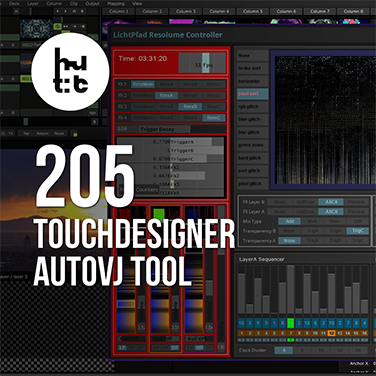
Intermediate · 5 modules · 13 hThis course is for VJs who already work in Resolume, Modul8 or VDMX and have hit the limits of a fixed tool. You build your own VJ tool in TouchDesigner, block by block: video players, a movie bin with crossfades and drag and drop, sound analysis, signal routing, a GLSL effects selector, a custom interface and a step sequencer with presets and a Premiere EDL cue player. You connect it to Resolume and control Resolume from TouchDesigner, so your current setup stays in use. The course ends with a walkthrough of my automatic VJ system, built for a 17-hour club night: clock dividers and sound analysis switch layers and effects, so it can carry a long night on its own without repetition.
- TouchDesigner foundations
- Sound-Reactive Systems
- Media Playback & Movie Bin
- System & UI
- Sequencing & EDL
TouchDesigner 301: 2D GLSL - Procedural Graphics and Postprocessing
Advanced · 4 modules · 6.9 hThis course shows the full range of what you can do with the GLSL TOP in TouchDesigner, except compute shaders: from generative textures to colour correction and video processing. You start with fragment-shader basics and learn to read and debug shaders. You build procedural images from coordinates: gradients, tiling and repeating patterns, wave distortions, noise, and distance fields in polar coordinates, and use them to visualise sound. Then you process images and video: tonal and colour correction, multi-pass and multi-sample filters, and effects driven by luminance and control maps. You end with stylised effects (pixelation, ASCII, bloom, halftone, old film, glitch and reaction-diffusion) and feedback systems, and learn to port shaders from Shadertoy.
- 2D GLSL Foundations
- Procedural Generation
- Optical Post-Processing
- Stylized & Generative Effects
After this course
Intermediate
How the course works
The course is recorded and you take it at your own pace.
Lessons open once a week on your own schedule, counted from the day you get access: it keeps a steady rhythm and does not overload you. If you want the whole course at once, write to us and we open full access.
43 h in total
4 levels, 25 modules, 75 lessons
Weekly · all on request
Price and what's included
VJing Path
- Access to all video recordings for 730 days
- The project files used in the lessons
What you get
- Access to all video recordings for 730 days
- The project files used in the lessons
Payment
The price is final and the same for everyone. It includes German VAT (19%). Buyers outside the EU and EU businesses with a valid VAT ID pay the same price; their invoice shows no VAT (reverse charge).
You can pay by card (Stripe), PayPal or bank transfer.
FAQ
01Can I pay in instalments?
Yes, in two parts: €1,195 now and the rest within 45 days.
02How long will I have access to the lessons?
730 days. If you need more time, write to us and we extend it.
03Why pay for the course if there are free tutorials on YouTube?
YouTube tutorials are made to teach one specific technique, usually without a system or a methodology. We teach you to understand systematically how the logic of node architecture works, with a balance between a practical and an academic approach.
04I work on a Mac. Will the course work for me?
Yes. Sections with Kinect or other depth cameras need Windows. More on requirements — see "What computer and software do I need?".
05What computer and software do I need?
Windows is more efficient for this work; a Mac works too, but with limits from 3D drivers and some Nvidia-only TouchDesigner operators. TouchDesigner 2023 or later: Windows 10/11 or macOS 13+ (Apple Silicon recommended); a GPU with Vulkan 1.1 and at least 4 GB of video memory, 8 GB or more recommended. Ableton Live 11 or later: Live 12 runs on Windows 10 (22H2) or 11, or macOS 11 or later (Intel Core i5 or Apple Silicon), with 8 GB of RAM. Substance Designer: Windows 11 (8 GB of video memory, 16 GB of RAM minimum) or a Mac with Apple Silicon on macOS 15 or later; Intel Macs are not supported. Resolume: Windows 10/11 with an Nvidia or AMD graphics card, or macOS 13.4 or later; 8 GB of RAM minimum, 16 GB recommended. The Kinect lessons need a Windows computer and a USB 3 adapter; on a Mac they do not run.
06Is the free version of the software enough?
TouchDesigner Non-Commercial is enough for the whole path, with the limits of the free licence.
07Is there code in the course?
Yes, gradually: a learning path brings together courses of different levels, so the code grows from start to finish — about 14 h of 43 h. In 101 and 102 you adapt short Python scripts and simple GLSL shaders; 205 uses Python for drag and drop and generated UI, and GLSL with Shadertoy porting; 301 is entirely about writing GLSL fragment shaders.
08Do you issue a certificate?
We don't issue certificates. What you take away is experience and the project files, and if you do all the assignments, a portfolio of your own works.
09Can I get an invoice for my employer or company?
Yes, we issue invoices to companies. Write to us before you pay.
10Are there subtitles?
Yes, every lesson has subtitles.
11How much time will the course take?
About 108–129 hours including practice: the course has 43 h of video, and each hour of video takes 2.5–3 hours to watch, rewatch and do the assignments.
12Which course should I choose?
Extreme is quick and affordable: TouchDesigner from zero to confident work. A Learning Path includes Extreme and adds a specialisation for a profession (AV, VJ, light, media art). Hou2Touch is the long, deep and most expensive route: TouchDesigner together with Houdini, for serious work across media and 3D production.
13Can I start from zero?
Yes: the path starts with Extreme I, which starts from zero, no TouchDesigner experience needed.
14Are project files included?
Yes, every course comes with its project files.
Didn't find your answer, or not sure the course fits you?
Telegram: https://t.me/prcdrl or write to support in your GetCourse account.
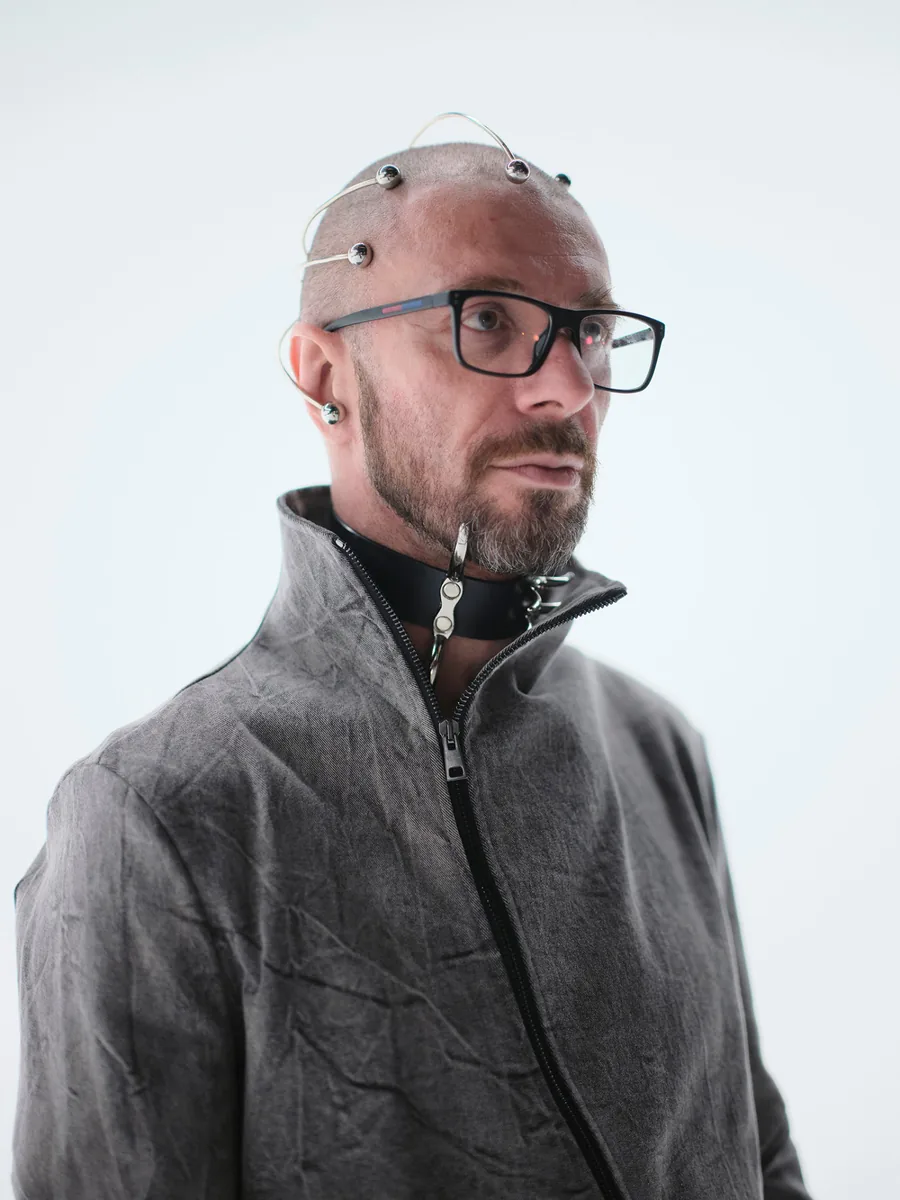
Stanislav Glazov
Media artist, technical director, founder of Hou2Touch
Stanislav started in computer graphics in 1998 with commercials and music videos, and has been teaching since 2001: Maya at RealTime School in Moscow and at SAE Institute in Munich, Houdini at Scream School, CG Event and the British Higher School of Art and Design (2008–2012). In 2009 he launched his own Houdini school, houdini-howto.com, and in 2014 he began teaching TouchDesigner. He was a character and VFX technical director on animated features at Caligari Film, Trixter and Scanline, working on rigging, cloth and hair pipelines, simulation and Maya API development. In 2010 he built the Houdini infographics pipeline for Kommersant TV, then moved into real-time visuals: video mapping at SILA SVETA and Visuals.108 (2011–2013) and, from 2013 to 2019, his own studio Licht.Pfad. He made the first Hou2Touch course in 2020 and built the school as a team in 2022. More than 2,000 people have studied with him.
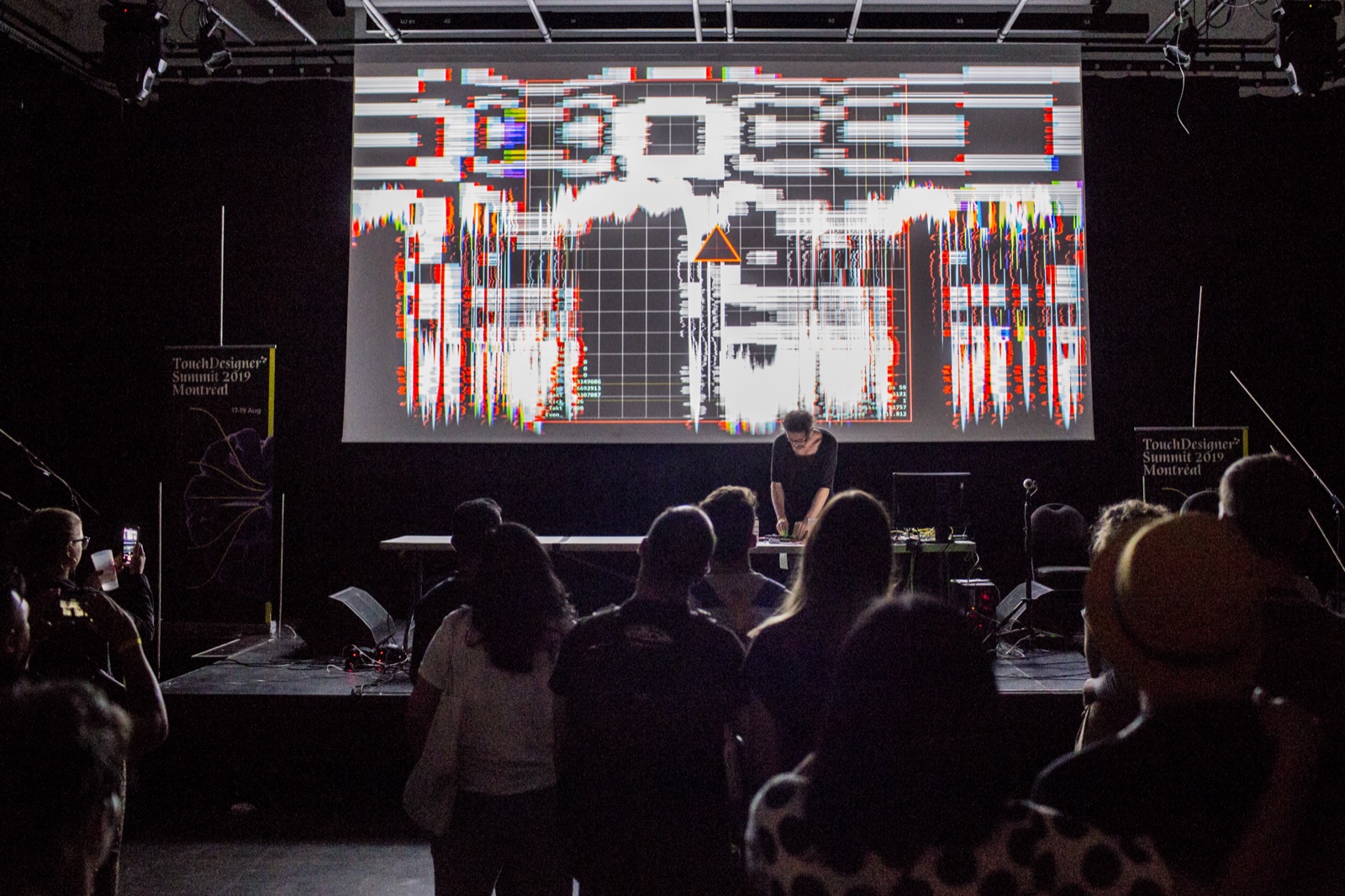
Shown at: Berlin Atonal · Ars Electronica · Mutek Montreal · Barbican · Berghain · Fête des Lumières Lyon · Unsound · Sonar Istanbul · L.E.V.
Worked with: Maxim Didenko · Berlin Ballet Company · Dasha Rush · Robert Lippok · Whitevoid
Companies and clients: Scanline · Trixter · SILA SVETA · Hyundai
Taught at: SAE Institute · Scream School · British Higher School of Art and Design · LPM Rome
Selected projects
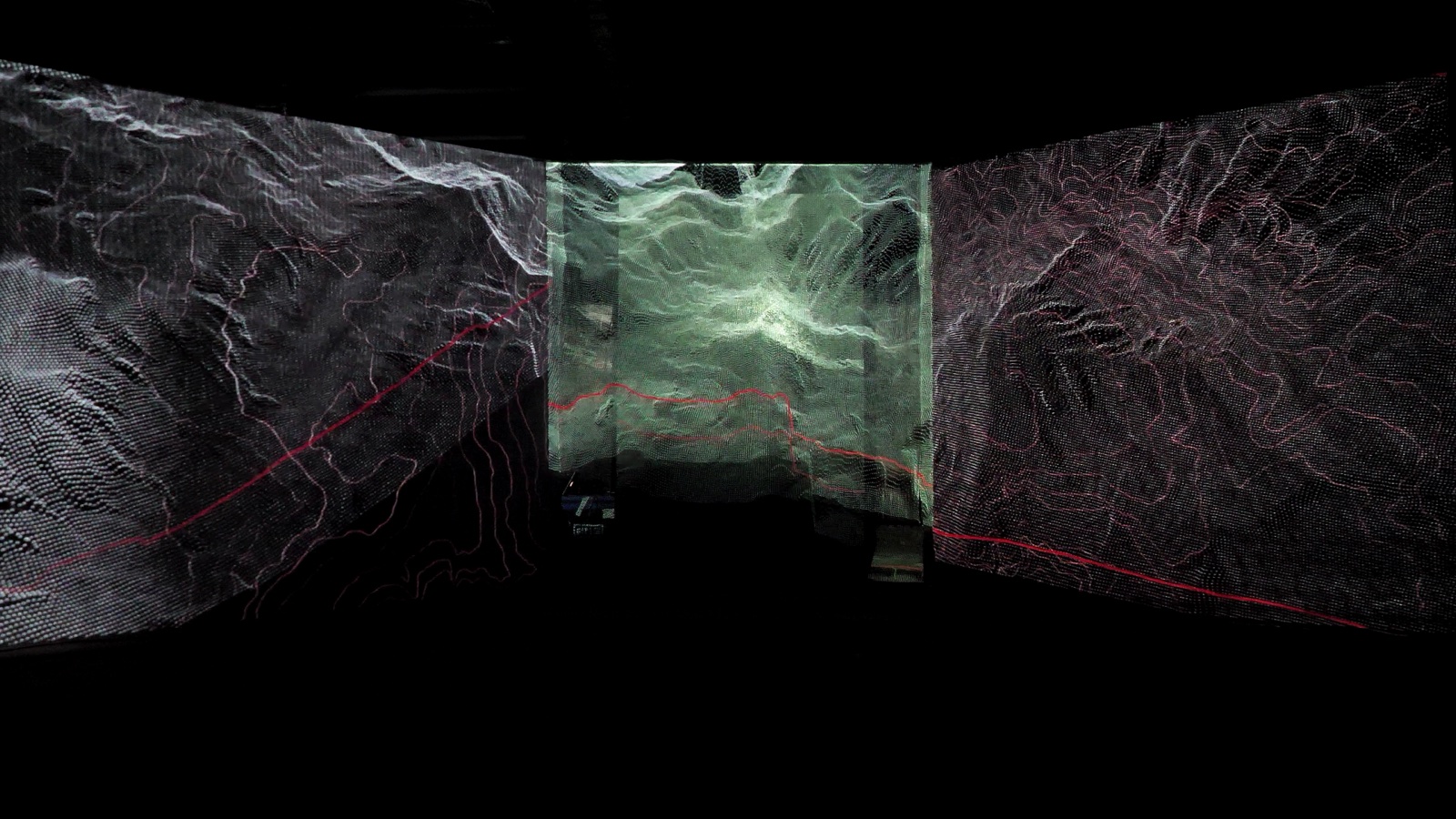
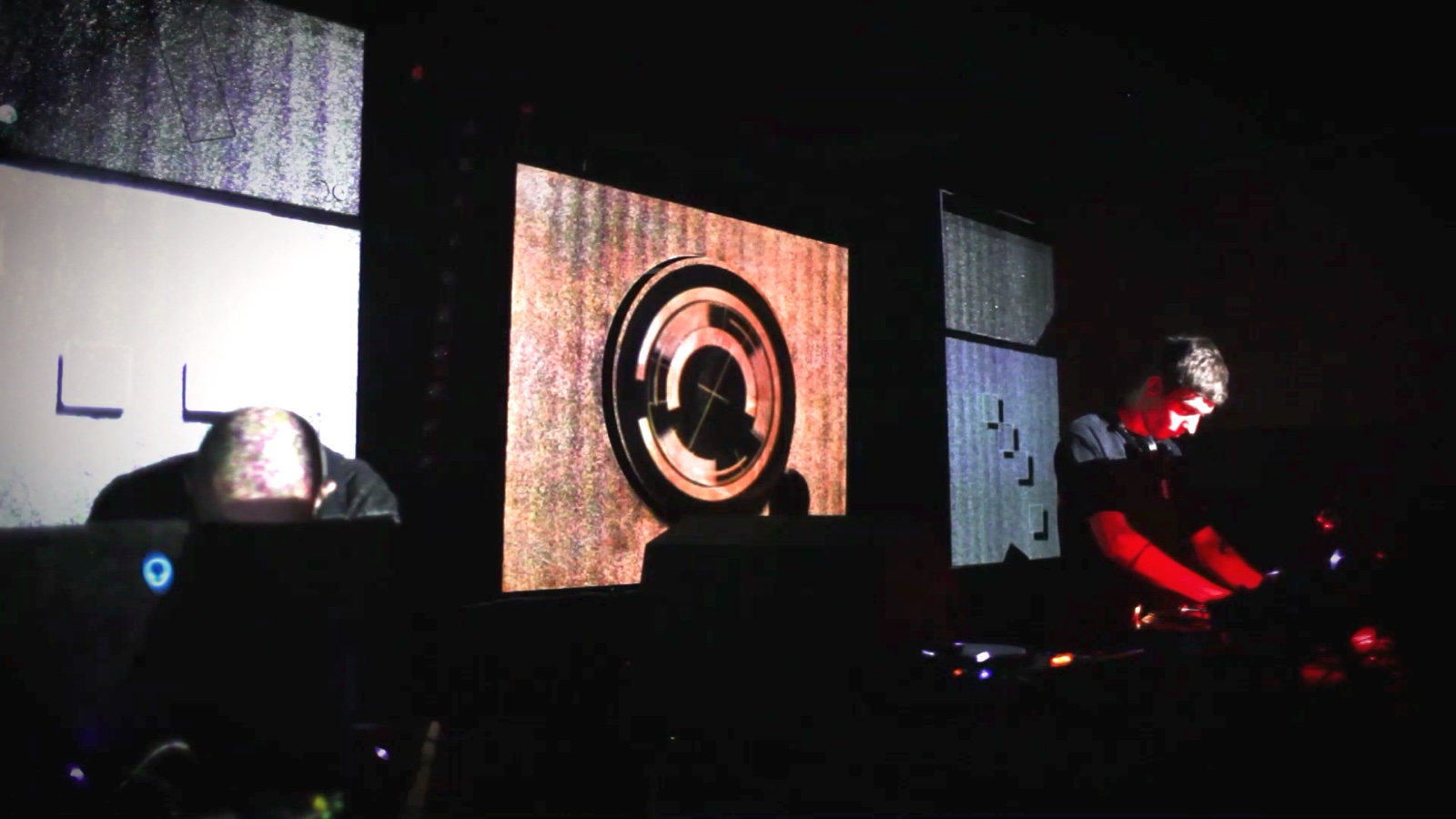
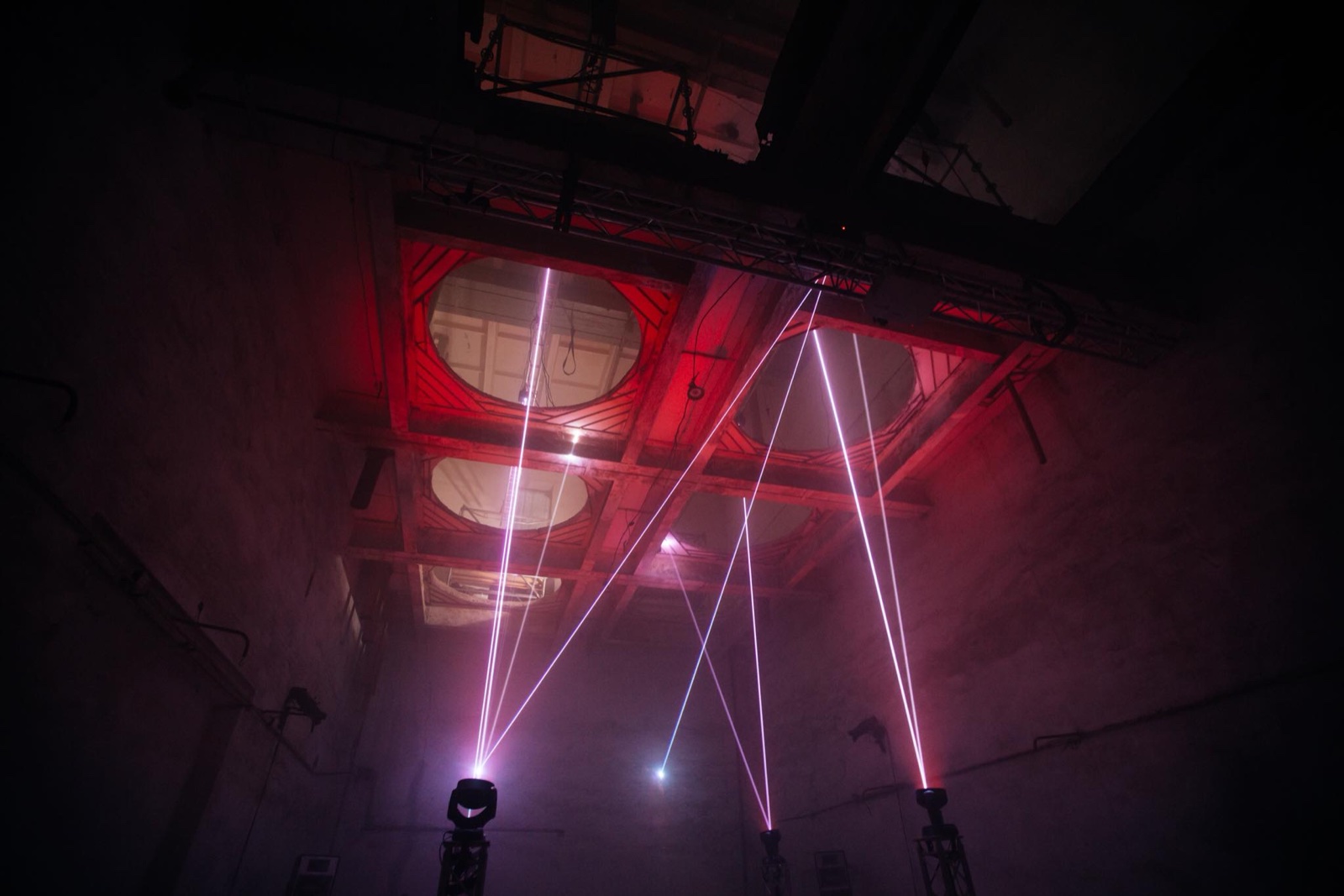
selected festivals & venues
Amazing Stanislaw! Thanks for sharing! Also to tell you that your new course is outstanding. Really wish I could take it!
The courses were detailed and provided some excellent examples and techniques that are difficult to find examples of elsewhere. You are definitely a world leading expert in TD.
The courses are great and are the best TD course's I've ever found. The use of a univeristy lesson plan approach coud help the structure of the courses (i.e. defined learning outcomes, overview of example aims, slightly more defined goals etc). I'm happy to help with some of the video production (i.e. RX7) or academic pedagogic approaches (i.e. learning outcome authorship) if needed. I have over 20 years of experience in the music industry and lecturing degree content, having designed 6 undergraduate and two postgraduate degree courses. I'm often in Berlin if you wan to chat!
You have always been very informative and have approached topics in a way that even most novice TD/Shader coders can get value from.
deep in researching and excellent approaches from point of view of proceduralism
all the topics are super, i cover by long my expectatives even push me to learn and achieve new objetives
VJing Path
- Access to all video recordings for 730 days
- The project files used in the lessons
Learning Paths & Courses
Related courses and learning paths.
- path_vj1current
 TouchDesigner · Ableton Live +2VJing Path
43 h video · €1,195
- extreme101beginner
 TouchDesigner101 Extreme I
Learn TouchDesigner from scratch: compositing, feedback, sound-reactive visuals, a custom movie player, machine sync and basic 3D scenes.
12 h video · €255
- vj205intermediate
 TouchDesigner · Resolume205 VJTool
Build your own sound-reactive VJ tool in TouchDesigner, with a movie bin, GLSL effects and a step sequencer, that also controls Resolume.
13 h video · €580
- glsl301advanced
 TouchDesigner301 2D GLSL
Write GLSL fragment shaders in TouchDesigner for procedural patterns, colour correction, stylised effects, feedback and Shadertoy ports.
6.9 h video · €380
Think procedural
11All courseshou2touch.com ↑hou2touch 2025 (c)
go up ^ License Agreement go up ^ License Agreement RU Privacy Policy